
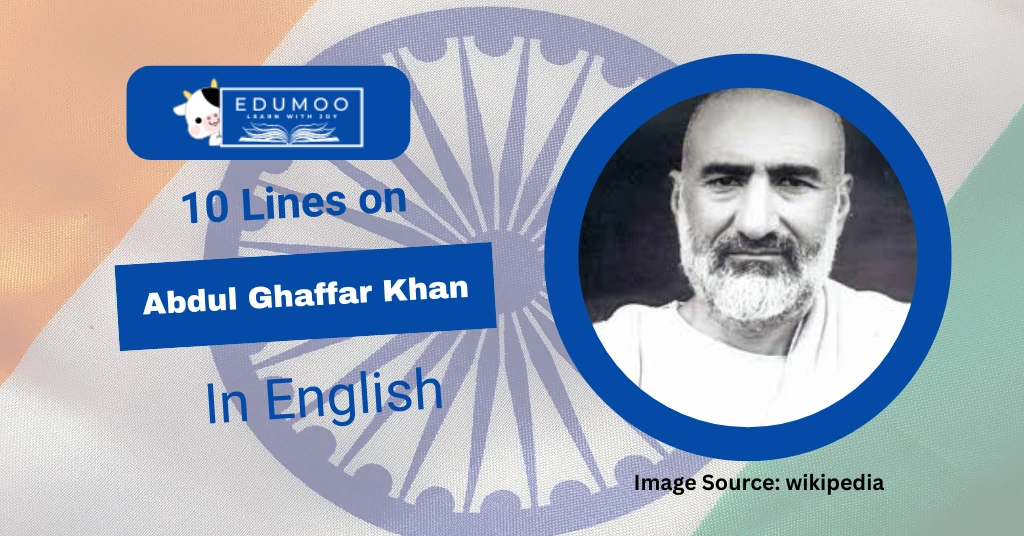
Abdul Ghaffar Khan, also known as “Frontier Gandhi,” was a great leader of India’s freedom struggle. He believed in peace, unity, and non-violence. He worked closely with Mahatma Gandhi and inspired many people, especially in the North-West Frontier region. In this blog, we will learn simple and easy information about his life.
10 Lines On Abdul Ghaffar Khan In English
- Abdul Ghaffar Khan was a great freedom fighter of India.
- He was born on 6 February 1890 in Utmanzai (now in Pakistan).
- He is also called “Frontier Gandhi.”
- He believed in non-violence and peace.
- He was a close follower of Mahatma Gandhi.
- He started the Khudai Khidmatgar movement.
- He worked for the education of people.
- He fought against British rule in India.
- He spent many years in jail.
- He is remembered as a symbol of peace and unity.
Essay On Abdul Ghaffar Khan In English In 250 Words
Abdul Ghaffar Khan was one of the greatest leaders of India’s freedom struggle. He was born on 6 February 1890 in a village called Utmanzai, which is now in Pakistan. He belonged to a Pashtun family. From a young age, he wanted to help people and improve society.
He believed strongly in non-violence and peace. He was deeply inspired by Mahatma Gandhi and followed his path. Because of this, he was given the title “Frontier Gandhi.” He started a movement called Khudai Khidmatgar, which means “Servants of God.” The members of this movement wore red shirts and worked for social reform and freedom.
Abdul Ghaffar Khan worked hard to promote education among people, especially in rural areas. He believed that education was the key to progress. He also fought bravely against British rule but always followed peaceful methods.
During the freedom struggle, he was arrested many times and spent several years in prison. Even after facing hardships, he never gave up his principles of non-violence and unity.
After India’s independence, he continued to work for peace and harmony. He was respected not only in India but also in other parts of the world.
Abdul Ghaffar Khan passed away on 20 January 1988. He is remembered as a symbol of courage, peace, and dedication. His life teaches us the importance of truth, non-violence, and service to humanity.
Essay On Abdul Ghaffar Khan In English In 650 Words
Abdul Ghaffar Khan, popularly known as Frontier Gandhi, was a great freedom fighter and social reformer. He was born on 6 February 1890 in Utmanzai, a village in the North-West Frontier Province, which is now part of Pakistan. He belonged to a respected Pashtun family. From his early childhood, he showed qualities of leadership, kindness, and a strong desire to help others.
He received his early education in his village and later studied in Peshawar. At that time, education was not very common among the Pashtun people. Abdul Ghaffar Khan realized that lack of education was one of the main reasons for backwardness in society. Therefore, he decided to dedicate his life to educating people and bringing social reform.
He started opening schools in different villages and encouraged people to send their children to school. He believed that education could change society and make people aware of their rights. His efforts helped many people understand the importance of learning and progress.
Abdul Ghaffar Khan was deeply influenced by the ideas of Mahatma Gandhi. He believed in non-violence, truth, and peaceful protest. Even though the Pashtun community was known for its bravery and warrior spirit, he taught them the power of peace and patience. This was not an easy task, but his strong belief and dedication helped him succeed.
In 1929, he founded the Khudai Khidmatgar movement, which means “Servants of God.” The members of this movement were also called “Red Shirts” because of their red uniforms. This movement aimed to serve society, promote unity, and fight against British rule through non-violent means. The Khudai Khidmatgars followed strict discipline and worked for the welfare of people.
Abdul Ghaffar Khan played an important role in India’s freedom struggle. He worked closely with leaders like Mahatma Gandhi and supported the Indian National Congress. He took part in many movements against British rule, including peaceful protests and campaigns.
Because of his active role in the freedom movement, he was arrested many times by the British government. He spent a large part of his life in prison. Despite facing hardships, he never lost hope and continued to follow the path of non-violence.
The partition of India in 1947 was a very difficult time for him. He was against the partition because he believed in unity among people. After partition, his region became part of Pakistan. Even then, he continued to work for peace and harmony.
Abdul Ghaffar Khan also faced challenges in Pakistan, where he was often misunderstood and even imprisoned. However, he remained committed to his principles. He always spoke about peace, unity, and brotherhood.
He received many honors for his contributions. In 1987, he was awarded the Bharat Ratna, India’s highest civilian award. This shows the respect and recognition he received for his work in promoting peace and freedom.
Abdul Ghaffar Khan passed away on 20 January 1988 at the age of 97. His death was mourned by people all over the world. He is remembered as a symbol of courage, peace, and dedication.
His life teaches us many important lessons. He showed that even in difficult situations, we should remain calm and follow the path of truth and non-violence. He also taught us the importance of education and social service.
In today’s world, where there is often conflict and violence, the teachings of Abdul Ghaffar Khan are very important. His message of peace and unity can help create a better society. Students and young people can learn from his life and try to follow his values.
In conclusion, Abdul Ghaffar Khan was not just a freedom fighter but also a great human being. His dedication to non-violence, education, and service makes him an inspiration for all. His legacy will continue to guide future generations towards peace and harmony.
Also Read: 10 Lines About Rainbow In English
Conclusion
Today, we have learnt 10 lines on Abdul Ghaffar Khan. Abdul Ghaffar Khan was a true leader who believed in peace and unity. His life is a great example for students and young people. By following his values of non-violence, honesty, and service, we can become better individuals and help make the world a peaceful place.